Hrafn Leó Guðjónsson · 20 October 2026
How big a grid connection do ten electric trucks need?
Smaller than most people think. At an industry seminar in Reykjavík recently, where the grid operators Veitur and RARIK presented their work on electrification, one participant asked whether the lead time for grid connections at depots was holding back the electrification of trucks. He said it was the most common answer he got from fleet operators on why they had not started.
I understand the answer. A fleet operator hears that an electric truck charges at 150 to 350 kW, multiplies by the number of trucks and gets a figure that calls for a new substation, months of waiting and a large bill. Waiting is the easy choice.
But the calculation is wrong. It assumes every truck charges at full power at the same time. That never happens at a depot where trucks come in during the afternoon and leave in the morning.
Time decides the power demand, not the charger
A truck driving 250 km a day uses about 330 kWh. If it comes in at 17:00 and leaves at 07:00 it has 14 hours to charge. That is about 24 kW on average. Not 350.
In a recent project for a haulage operator electrifying its fleet in phases, we simulated this minute by minute with real driving, 200 to 300 km per truck per day, and a full battery required every morning. The result:
| Phase | Trucks | Peak power | Grid connection |
|---|---|---|---|
| Now | 2 | about 70 kW | 315 A |
| In 2 years | 4 | about 135 kW | 315 A |
| Half the fleet | 10 | about 215 kW | 315 to 400 A |
| Full fleet | 20 | about 525 kW | 900 A |
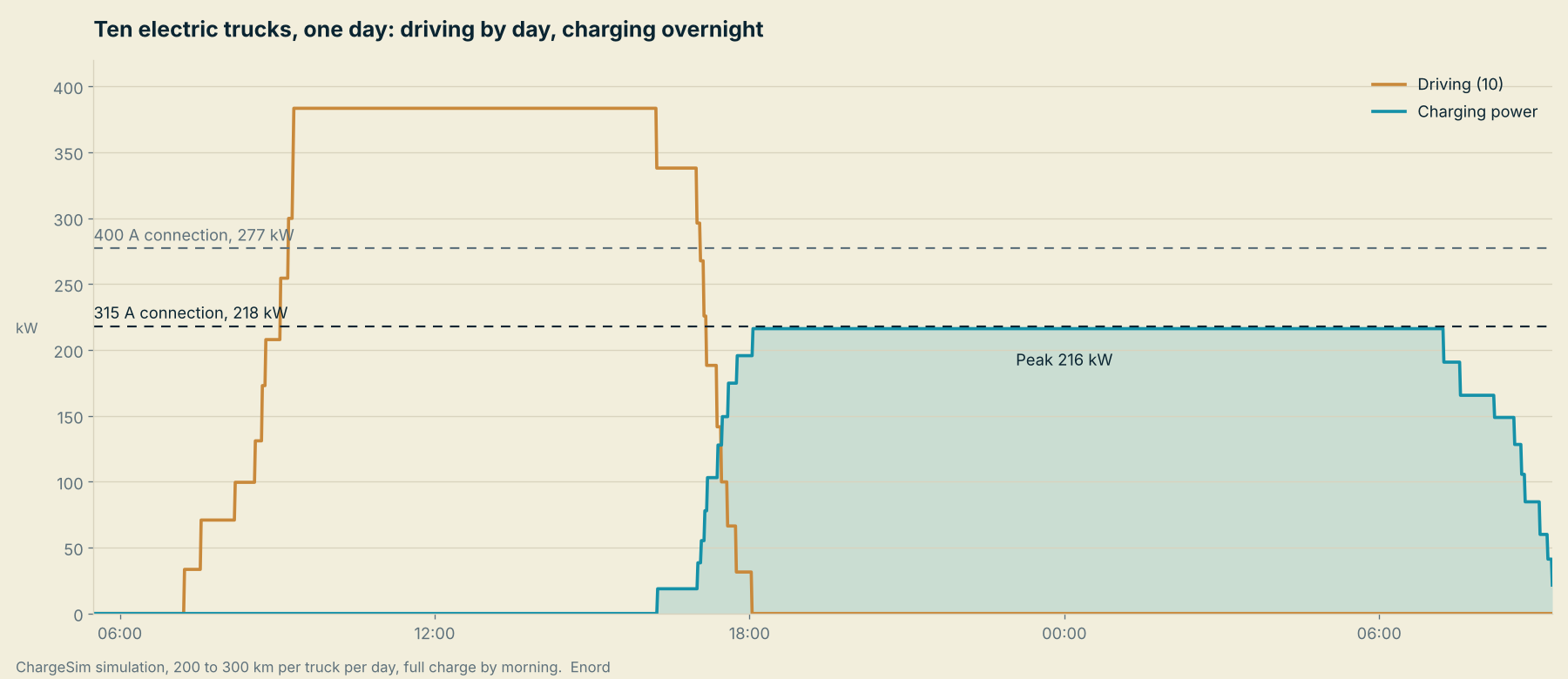
Ten trucks need about 215 kW. That is at the upper limit of a 315 A connection, so 400 A gives headroom, and both are available without a substation on site. None of the ten chargers needs to deliver more than 25 kW. Charging starts when the first trucks arrive around four in the afternoon and the whole fleet is fully charged before departure in the morning. Twenty trucks call for 900 A, and then a substation has to be planned for.
An oversized connection costs twice
An oversized grid connection is expensive. The connection fee to the grid operator rises with the size of the connection and is paid up front, whether the capacity is used or not. After that, a capacity charge is paid every month on the highest peak, not on the energy that goes into the trucks. Ten trucks on ten 150 kW chargers without load management can hit a 1,500 kW peak in the first hour after the trucks arrive, and the fleet pays for those 1,500 kW all year. The simulation shows that 215 kW is enough to have every truck fully charged by morning.
Load management that holds the peak at 215 kW instead of 1,500 kW therefore lowers both the investment and the running cost, and it costs little. It is built into most chargers and only needs to be set correctly from the timetable.
What does this mean for those who are waiting?
- Starting is cheap. Two to six trucks fit on a 315 A connection, which many depots already have or can get without a substation. There is no reason to wait for the large connection before putting the first trucks into service.
- The large connection comes later, and with notice. When the simulation shows when 315 A is no longer enough, the upgrade can be applied for two years before it is needed. The grid operator gets a realistic figure instead of a peak-power calculation, and the lead time stops being the bottleneck.
- Civil works once. Cable routes and foundations for the whole fleet are laid in the first phase. The yard is dug up once, not three times.
The question to ask
Not “how big a connection do we need?” but “how many trucks can the connection we have carry?”. The answer is usually higher than people expect, and it comes from a timetable, fleet data and a site plan of the depot. No measurements are needed.
Grid connection lead times can delay the final phase. They are rarely a reason to postpone starting.
The example report from the project, anonymised with the client's permission, is available on the project page.